Hyundai Engineering Web toolbar

₱778 Billion Railway 95 KM Connecting Connecting Manila to Clark will open on 2022

₱821 Billion Railway 95 KM Connecting Connecting Manila to Clark will open on 2022


Philippines awards final two contracts for Malolos – Clark line

PHILIPPINE National Railways (PNR) and the Philippines Department of Transportation (DOTr) have awarded the two remaining construction contracts for the 53km Malolos – Clark section of its North-South Commuter Railway (NSCR) project.

The contracts, designated packages 2 and 3, cover a total of 28 km of viaduct and six stations in the northern province of Pampanga, and have a combined value of ₱56.47 billion Php ($1.17 billion US Dollars ).

Package 2, worth ₱ 33.7 illion Php, was awarded to a joint venture of Acciona Construction Philippines and Daelim Industrial, and covers the construction of 16km of viaduct and stations in Minalin, Santo Tomas and San Fernando.

Package 3, worth ₱22.77 billion Php, was awarded to Italian-Thai Development, and covers the construction of 12km of viaduct and stations in San Fernando, Angeles and Mabalacat.

The contracts are the last two of five packages for the section. Package 1 was awarded to a Hyundai-led consortium on September 18, and Packages 4 and 5 were awarded on August 1. Package 4 was awarded to a partnership of EEI and Acciona, and 5 to Posco, Korea.

Construction on the Malolos – Clark line is scheduled to begin in November, with the section currently expected to begin partial operation in 2022. When completed, the new railway will connect Malolos, Bulacan, to Clark International Airport in Mabalacat, offering end-to-end journey times of 30-35 minutes, compared with journey of 1h 30min.

The section is part of the larger 148km NSCR project, which is expected to cost around ₱777.55 billion, and is co-financed by the Asian Development Bank (ADB) and the Japanese International Cooperation Agency (Jica).

Philippines awards contract for Malolos – Clark project

$573 million US Dollars contract to construct a section of the Malolos – Clark Railway project was ararded to a Hyundai-led consortium.

The Package 1 contract, which was awarded on September 18, covers the construction of 17km of viaduct northwest of Manila, and two elevated stations in Calumpit and Apalit.  

The consortium, led by Hyundai Engineering and Construction, which holds a 57.5% controlling share, also comprises Dong-ah Geological Engineering, Korea, and Megawide Construction, Philippines.

The contract is part of the planned 53km Malolos – Clark Railway, which will connect Malolos, a city north of Manila, with Clark International Airport and economic zone.

Package 1 follows the awarding of contracts for Package 4 to a partnership of EEI and Acciona Construction Philippines, and Package 5 to Posco, Korea. The contracts cover the construction of 6.3km of main line and 1.6km of depot access line, as well as Clark airport station, a depot at Mabalacat, an operations control centre (OCC) and other buildings.

Contracts for two packages have yet to be awarded. These are:

* Package 2, which covers construction of 16km including San Fernando station, and

* Package 3, which covers 12km of line including Angeles station.

Malolos – Clark is the second of three phases in the country’s broader 148km North-South Commuter Railway (NSCR) project, which will run between New Clark City, Pampanga, and Calambra, Laguna and cost around ₱777.55 billion ($15.8 billion US Dollars) when completed.

The NSCR is currently scheduled for completion is 2025, and is intended to reduce congestion across the Manila metropolitan area.

The project is partially funded through financial support from the Asian Development Bank (ADB) and the Japanese International Cooperation Agency (Jica). Read more from Rail journal page 1 and two 
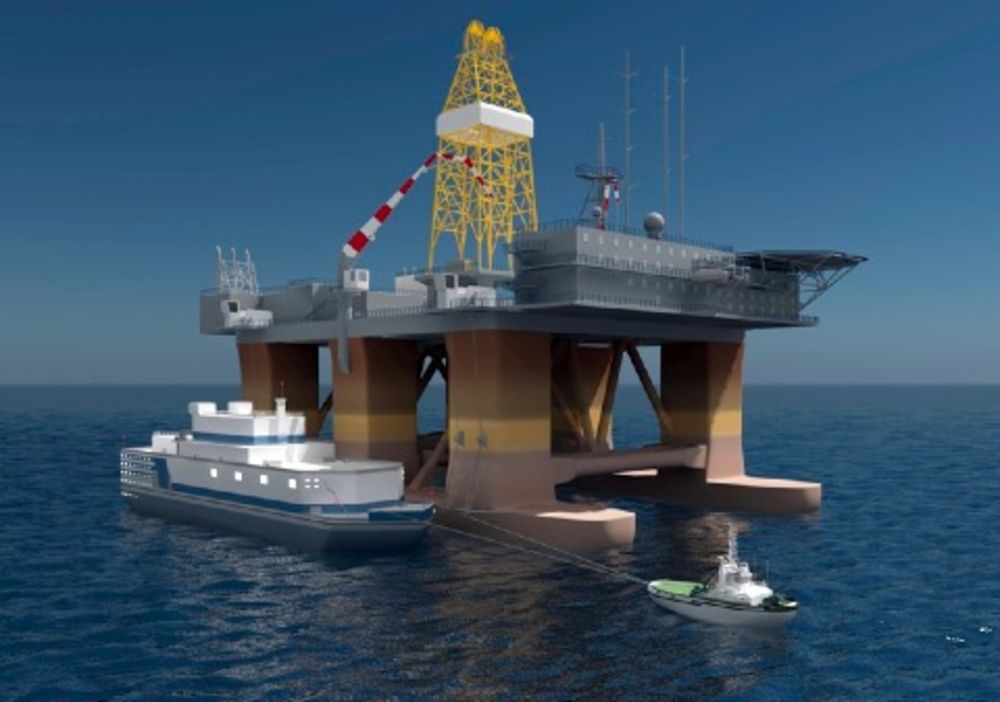

China, Japan, Korea, Russia compete for $2 Billion Nuclear Plant, LNG Philippines Gas project

Russia Floating Nuclear Power Plant Technology
Russia Floating Nuclear Power Plant Technology. illustration: popsci.com

China, Japan compete for $2bn Philippine gas project


China and Japan are competing for a $2-billion liquefied natural gas (LNG) project in the Philippines, Energy Secretary Alfonso Cusi told the Nikkei Asian Review.

Over 20 companies from eight countries have proposed partnerships with state-owned Philippine National Oil Corp. for an LNG receiving terminal at the southern part of Luzon Island. Cusi said his team is still reviewing funding and technology options.

"We are talking to China [and] Japan," he said. "We are looking at which can offer the best in terms of funding. It's too early to say who is more advanced -- there are so many things to look into."

Countries that offer the best financing options usually pick their own domestic contractors. Cusi said Tokyo Gas, Osaka Gas, and a number of Chinese state-owned and private companies have shown interest.

Cusi is vice chairman of President Rodrigo Duterte's PDP-Laban party. He has traveled to Beijing and Tokyo this year to solicit energy investments for the Philippines, which runs into alerts and price spikes for electricity whenever the country's lone LNG facility undergoes maintenance.

Cusi said he plans to travel to South Korea and Russia, and does not favor any particular power-generating technology. He said Malampaya, the only source of natural gas in the Philippines, is expected to be exhausted by 2024. The gas field operated by a consortium led by Royal Dutch Shell provides 40-45% of Luzon island's power requirements. Luzon accounts for two-thirds of gross domestic product in the Philippines.

The proposed terminal could import LNG from other countries while alternate Philippine resources are being developed. These include gas fields in the South China Sea in dispute with China. The terminal's plant will initially generate around 200 megawatts, but can expand to 800MW. Cusi hopes to find an investor this year.

Duterte is targeting total household electrification before he leaves office in 2022. As of December, over 90% of households had access to energy. Cusi also said he is studying the possibility of activating a $2 billion nuclear power plant on the Bataan peninsula. The project, initiated under President Ferdinand Marcos in the 1970s but never activated, is located near an earthquake fault line.

Sulu Province of Southern Philippines could have the first ever operating 100 MW Nuclear Power Plant this year according to the report (see here) - Nikkei Asian Review

Malaysia inspects North Korean coal ship for possible U.N. sanctions breach

North Korean Cargo Ship KUM YA formerly named lucky star 7

North Korean Cargo Ship "KUM YA" (former Lucky Star 7)

By James Pearson, Rozanna Latiff and Tom AllardKUALA LUMPUR, March 29 

(Reuters) - Malaysia briefly prevented a North Korean ship carrying coal from entering its port in Penang because of a suspected breach of United Nations sanctions, a port worker and Malaysian maritime officials told Reuters on Wednesday

The KUM YA (Formerly Lucky Star 7) was carrying 6,300 metric tons of anthracite coal, according to a worker at Penang Port who spoke to Reuters on condition of anonymity. It was later allowed to dock, where an inspection team accompanied by an armed escort boarded the ship.
 
A December 2016U.N. Security Council resolution placed a cap on exports of North Korean coal, and urged member states to apply extra scrutiny on North Korean ships.

Production of coal in North Korea is state-controlled and its exports are a key source of hard currency for the isolated country's banned nuclear and ballistic missile programs.
 
Relations between North Korea and Malaysia, which have been friendly for decades, have soured following the February assassination of North Korean leader Kim Jong Un's half-brother at Kuala Lumpur International Airport.
 
The North Korean ship had been initially prevented from entering Penang Port due to a possible breach of U.N. sanctions, MMEA deputy director-general of operations Zulkifli Abu Bakar, told Reuters without offering further details.
 
It was unclear what the inspectors were checking on. The United Nations in its annual reports on how members have complied with sanctions have cited a number of instances over the past decade in which North Korean missile parts and coal connected to sanctioned entities were trans-shipped through Malaysia.
 
Malaysia is one of the few countries in the world which buys North Korean coal, with China by far the biggest importer.

LUCKY STAR
 
The KUM YA was recently re-flagged as a North Korean ship, changing its name from Lucky Star 7 in November last year, according to the Equasis shipping database.
 
 It was registered on Feb. 13 to North Korean shipping company Sonchonggang Water Transport, according to copies of the ship's registration documents, which were issued by North Korea'sMaritime Administration, and seen by Reuters.
 
The ship was carrying 20 crew members, and was scheduled to sail onto Singapore, the port worker said.
 
The ship listed its port of origin as Busan, South Korea. However, shipping data in Thomson Reuters Eikon shows the cargo was loaded at the Huaneng Shandong Power Station Weihai, a coal-fired power plant. It then sailed to Penang through the South China Sea and the Malacca Strait, the data shows.

Null
Source: (http://tmsnrt.rs/2ofxNXe)
 
China halted all coal imports from North Korea starting on Feb. 26, amid growing tensions on the Korean Peninsula following one of a series of Pyongyang's missile tests.
 
Malaysia's foreign ministry told officials at Penang Port not to let the ship dock before an inspection team had it "declared safe," the port worker said.
 
The Malaysian Maritime Enforcement Agency (MMEA) confirmed the ship had been stopped following instructions from Malaysia's foreign ministry, which did not immediately respond to requests for comment.
 
 "Many North Korean ships call on our ports and we never had problems. Just over the recent months, there have been problems," the port worker told Reuters. "We have never received directives to stop North Korean ships before."

NOT CONFISCATED
 
The KUM YA was first stopped at sea before being allowed to dock in port where it was immediately cordoned off, the port worker said.
 
 "Minerals and Geoscience Department officials were then called to inspect the cargo on board. The department officers were told to confirm it was indeed coal on board," the port worker said.
 
The coal was being unloaded on Wednesday afternoon and has not been confiscated, the port worker said.
 
Since 2011, Malaysia has imported over 2 million metric tons of coal a year, according to government statistics, which are not broken down by country of origin.
 
The KUM YA shipment was handled by Malaysian freight forwarding company Alim Maritime Sdn Bhd, the port worker said. An Alim Maritime official reached by telephone declined to comment.
 
The KUM YA can hold up to 6,843 metric tonnes of cargo, according to Equasis, meaning it was 92 percent full when it arrived in Penang.

Merging Hyundai Amco and Hyundai Engineering this April; We expect more better

Hyundai Motor Group's two construction affiliates, Hyundai Amco and Hyundai Engineering, are scheduled for merging into a single entity this April 1, 2014.

The merger is expected to reshape the construction and engineering industry, as the entity that will be a new, competitive player in the market.

The Hyundai Amco and Hyundai Engineering, respective boards' have decided on the merger during respective meetings and ended up this final decision.

Hyundai Engineering will take over Hyundai Amco, as the former's stock price is higher than the latter's and it has twice as many workers. The two firms are still unlisted.

Searching for FAST but affordable web hosting service? We recommend SOMOSOTECH at [ www.somosotech.com ] with 30 days money back guarantee, its worthy to try .

Hyundai Amco was set up in 2002 for construction and expansion of the group's manufacturing facilities and research institutes. It ranked 13th among construction firms here in construction capacity.

Hyundai Engineering is a member of Hyundai Engineering and Construction Group which holds a 75-percent stake in the former. It specializes in plant construction. Both HEC and HDEC are part and under the umbrella of Hyundai Motors Group.

The merger is part of the group's strategy to expand its construction business,.

"By developing more competitiveness and expertise in plant construction, we aim to make the single entity one of the world's top 10 engineering companies by 2025, with 20 trillion won in sales," this is our goal.

The combined sales of the two firms were 6 trillion won last year, and the combined assets were 4 trillion won. The new entity will rank 10th in terms of construction capacity and eighth in terms of sales.

The merger will create a considerable synergy as the two firms have specialties in different businesses ― while Hyundai Amco focuses on construction of buildings, roads, ports and houses, Hyundai Engineering is good at planning and constructing petrochemical and electric power plants.

"Through the merger, the single company will have a diverse portfolio ranging from industrial plants to housing and civil engineering. It will have an advantage in winning construction bids in both domestic and overseas projects with a combination of Hyundai Engineering's planning capacity and Amco's construction ability".

The new firm's business will be expanded to oil and gas plant construction, Hyundai Engineering & Construction (HDEC)'s business in the field may be transferred to the new company.

[ Hyundai Amco/ Hyundai Engineering]


Searching for FAST but affordable web hosting service? We recommend SOMOSOTECH at [ www.somosotech.com ] with 30 days money back guarantee, its worthy to try .

Hyundai Heavy Industries (HHI) promoted CEO Jae-sung LEE as new chairman

Hyundai Heavy Industries (HHI), the world's top-tier shipyard, said Thursday that it promoted Lee Jae-sung, from CEO to chairman.

This is part of a management reshuffle designed to defy concerns over corporate profitability amid the continued market downturn.

HHI said the promotion was mostly aimed at guaranteeing management independency.

The position became vacant after former chairman Min Kye-shik left the shipbuilder in December 2011.

President Kim Oe-hyun will be in charge of shipbuilding, marine and plant businesses. Kim Jeong-rae, will move to take charge of the firm's engine, electronics, green energy and construction equipment businesses, according to the statement.

"The reshuffle is aimed at increasing the agility of the company to react to change in markets and weather market downturns by introducing a responsible management system," an HHI official said.

The global shipbuilding industry is seeing signs of gradual improvement thanks to increasing orders from major ship-owners amid economic recovery in the United States and Europe.

But HHI officials say the time isn't ripe to expect imminent profit hikes in coming quarters because the market outlook remains negative.

yckim@koreatimes.co.k

Hyundai Engineering & Construction's cumulative overseas orders top $100 Billion Dollars

HDEC workers leave for Antarctic from New Zealand in mid-November to complete South Korea's second research station in the frozen continent by early next year. (Yonhap file photo)

Hyundai Engineering and Construction Co. (HDEC), South Korea's largest builder, said Sunday that its cumulative overseas orders have topped US$100 billion, 48 years after its first inroad into the offshore construction market.

HDEC, now affiliated with the Hyundai Motor Group, said it recently won a $1.4 billion contract to build an oil refinery plant in Latin America, raising the amount of its cumulative overseas orders to $101.05 billion (107 trillion won).

The milestone has been achieved 48 years after the contractor obtained an order to build an expressway in Thailand in 1965 in the company's first overseas project, company officials said.

HDEC has since carried out 780 more construction projects in 55 countries worldwide.

HDEC's aggregate volume of offshore orders accounts for approximately 17 percent of the South Korean construction sector's cumulative overseas orders of $597 billion, they noted.

They added 54 percent of HDEC's overseas orders came from the Middle East, with Asia accounting for 32 percent.

(Yonhap)

Hyundai Heavy Launches New 2,300 metric tons Stealth Frigate – 3D anti-aircraft, anti-ship missiles; OK for Philippine Navy?

Hyundai Heavy Industries (HHI), the world's biggest shipbuilder, held a launch ceremony for its fifth frigate, ROKS Jeonbuk. The launch ceremony was attended by the Chief of Naval Operations Admiral Mr. Hwang Ki-chul, governor of Northern Jeolla Province Mr. Kim Wan-ju, Hyundai Heavy's president & CEO Mr. Lee Jai-seong and other government and military officials in Ulsan shipyard. Photo: navyrecognition.com

Shipbuilder Hyundai Heavy Industries (HHI) held a launch ceremony today for its fifth frigate, ROKS Jeonbuk.

The launch ceremony was attended by the Chief of Naval Operations Admiral Hwang Ki-chul, governor of Northern Jeolla Province Kim Wan-ju, Hyundai Heavy's president and CEO Lee Jai-seong and other government and military officials in Ulsan shipyard.

The Jeonbuk frigate has greatly improved capabilities with its weapon and sensors including new 3-D radar, antiaircraft and antiship missiles, and sonar and torpedo acoustic counter measures. In addition, the vessel uses stealth technology to minimize the exposure to electromagnetic waves. More than 90% of major equipment is locally developed and sourced.

The 2,300-metric-ton frigate, measuring 114 meters long, 14 wide and 25 deep, can sail at a maximum speed of 30 knots with a crew of 120. The frigate will be delivered to the Korean Navy in December 2014.

The Ulsan, South Korea-based shipbuilder delivered its third frigate ROKS Incheon in January this year and is also currently building its fourth frigate ROKS Gyeonggi scheduled to be delivered in October 2014.

Since constructing and delivering the first Korean-built frigate ROKS Ulsan in 1980, Hyundai Heavy has grown as a leading naval shipbuilder by delivering 63 naval ships including the first and the third Korean Aegis destroyers, three KDX-II destroyers, five frigates, three submarines and 29 patrol salvage ships.

Hyundai Heavy have shown its interest to compete with other global bidders for the recent invitation from the Philippines for 2 new frigates.

english.hhi.co.kr

Hyundai ix35 Series II brings engineering and pricing revisions

The Hyundai ix35 small SUV has been given a mid-life refresh that includes updated petrol engines, revised suspension tuning and small price increases for most models.

A $26,990 starting price continues for the base model ix35 Active 2WD, though mid-spec Elite and range-topping Highlander models increase by $300-$400.

Petrol four-cylinders in 2.0-litre and 2.4-litre sizes continue but this time they feature direct fuel injection.

The 'Nu' 2.0-litre, already found in the mid-size i40, produces the same 122kW as the previous 2.0L but increases torque output from 197Nm to 205Nm, with fuel consumption improving from 8.5 litres per 100km to 8.2L/100km for the manual gearbox or 8.4L/100km for the six-speed auto.

The 'Theta' 2.4-litre increases both power and torque – by 6kW to 136kW and by 13Nm to 240Nm. Efficiency drops, however, from 9.2L/100km to 9.8L/100km.

A 2.0-litre turbo diesel carries over, with the 135kW/392Nm four-cylinder again offered in the Elite and Highlander trim grades.

Hyundai Australia is continuing to offer the European-built Special Edition, priced from $30,990 for a 2WD auto or from $35,990 for an AWD auto.

Other small changes for the Hyundai ix35 include revised headlight treatment, new 17- and 18-inch alloy wheel designs, standard faux-metal roof rails, soft-touch door trim for Elite and Highlander models, and a rear seat with recline function.

Hyundai Australia says it has also spent more time working on the ix35s suspension and steering, trying to address areas of criticism for the vehicle.

The Hyundai ix35 Series II is on sale now.

Car Advice

HDEC; a South Korean contractor denounced for USD2.1 million debt refusals of Vietnam's Hyupjin Vina Company

The five-star Marriott Hotel in Tu Liem District's My Dinh Commune Vietnam

VietNamNet Bridge – Thirty nine Vietnamese sub-contractors have accused South Korea-owned Hyupjin Vina Company of refusing the debt of VND44 billion (USD2.1 million), allegedly owed them.

In a petition sent to DTiNews, the Vietnamese companies said they are subcontractors, providing materials, equipment and aid to the electrical engineering system installation, for the luxury Marriott Hotel project in My Dinh Commune in Hanoi.

Dinh Van Khoi, Deputy Director of Construction Machinery Joint Stock Company No.4. (Coma4), one of the sub-contractors, said the Marriott Hotel project is owned by he Binh Minh Import Export Production and Trade Co. (Bitexco) and Bitexco signed a contract with South Korea's Hyundai Engineering & Construction Company.

After that, Hyundai Engineering & Construction Company signed a contract with subcontractor Hyupjin Vina Company at the representative's office in HCM City.

Then Hyupjin Vina Company signed a deal with 39 Vietnamese subcontractors who will provide materials, equipment and electrical engineering systems for the hotel. Under the contract, the Vietnamese side finished their work according to documents agreed by the two sides.

After their work was completed, Hyupjin Vina should have paid the 39 Vietnamese subcontractors a total VND44 billion. But, Hyupjin Vina suddenly announced their bankruptcy, and their inability to pay the debt.

Hyupjin Vina said that Hyundai Engineering & Construction Company still owes them more than USD3.5 million; therefore, they could not pay the debt to the Vietnamese sub-contractors.

Meanwhile, Hyundai Engineering & Construction Company denied this, saying that Hyupjin Vina has still owes them over USD4.2 million.

The Vietnamese sub-contractors have been seeking help from the two South Korean firms, but the firms refused to do this.

Many workers from the Vietnamese company gathered in front of the Marriott Hotel to strike for their rights. They faced the security people blocking the site and no one else appeared to deal with their problem.

Mr. Khoi said they sent a petition to Vietnamese management agencies, but, the problem has not yet been settled.

"We do not know about debt problems between the two South Korean companies, but Hyundai is the main contractor of the project, thus, they should take responsibility for this. We also expect the involvement of Bitexco in order to protect its project," Khoi noted.

DTiNews reporter contacted Hyundai Engineering & Construction and the company said it will provide information about the case as soon as possible.

DTiNews will continue updating the information of the case.

With report from DTriNews

Consortium led by Hyundai HDEC wins US$522 Million order from Sri Lanka

A consortium led by Hyundai Engineering and Construction (HDEC), South Korea's largest builder, has won a US$522 million Dollars order to build an integrated resort in Sri Lanka

Hyundai Engineering and Construction (HDEC) and  Keangnam Enterprises, a mid-sized builder -- are set to complete the resort in Colombo by 2017 under a deal with a subsidiary of Sri Lanka's top conglomerate, John Keells Holdings PLC.

Hyundai E&C said it holds a 65 percent stake in the project, or $339 million, while Keangnam Enterprises has a 25 percent one, or $130 million won, and Sri Lanka's Nawaloka holds the rest.

Shares of HDEC were trading at 61,700 won ($57) on the Seoul bourse as of 10:41 a.m., up 1.48 percent from the previous session's close.

Shares of Keangnam Enterprises, meanwhile, were trading at 5,230 won on the Seoul bourse as of 10:41 a.m., unchanged from the previous session's close.

Hyundai Engineering adopted Autodesk 3D software for Plant Design

Hyundai Engineering Co. Ltd., has adopted a 3D model-based design workflow driven by Autodesk Plant Design Suite, a comprehensive solution for designing, modeling, and constructing plant projects.

The Company piloted the use of the software on the A'Seeb Wastewater Treatment Plant project '" a wastewater treatment and recycling plant, capable of handling 80,000 tons of water in Seeb, Muscat, Oman the most populous region of the Sultanate of Oman.

Recognizing the clear industry shift from 2D- to 3D-based industrial and environmental plant design, Hyundai Engineering saw the need to invest in a 3D design solution.

Autodesk Plant Design Suite stood apart from other products on the market because it offered an affordable, flexible and comprehensive solution. The Suite provides design and modeling tools that are compatible with one another, which helps improve multi-discipline collaboration. It also enables 3D visualization, allowing project stakeholders to communicate more easily and effectively.

With Autodesk Plant Design Suite, Hyundai Engineering was able to not only deliver the A'Seeb Wastewater Treatment Plant project within budget and on schedule; the company also improved efficiency both in design and communication, while bringing about technological innovation.

A variety of tools contained in the suite were used on the project. For example, AutoCAD Plant 3D software simplified the modeling of pipeline, and enabled engineers to directly exchange basic data in the 3D models and drawings, helping all parties involved stay up-to-date. Also, Autodesk Navisworks Manage software was used to integrate designs created with various applications and produce a visualization of the integrated model that was used to detect problems early in the design stage of the project.

"Hyundai Engineering's aim was to ensure consistency and quality of 3D design data involved in the plant project. With Autodesk Plant 3D, we were able to implement a 3D wastewater treatment plant design system, which meant we were able to complete the development of a 3D design system that could be applied to various plant projects going forward," said Lee Seungsoo, section chief, Hyundai Engineering IT team.

Autodesk Plant Design Suite 2014 provides comprehensive plant design, intelligent 3D modeling and review software in an economical package. The Suite combines tools that enable intelligent, model-based processes to be utilized throughout project execution to help improve design efficiency and simplify coordination among process plant design stakeholders.

Building on the power of AutoCAD software and Autodesk 360 cloud services, the Suite adds plant-specific content and functionality to drive greater productivity and better project coordination, helping projects stay on schedule and within budget.

Hyundai Motors opens Nurburgring Test Centre in Germany

The Hyundai testing facility at Nürburgring

Hyundai has officially opened its 6.6 million Euro test centre in Germany at the famous Nurburgring.

Boosting the Hyundai Motor's brand's R&D operations in Europe, the new centre for testing provides Hyundai with a full-time presence at the iconic Nurburgring circuit, allowing it to further evaluate and develop the durability and driving dynamics of its vehicles 'more effectively and more often'.

Construction of the Centre began in June 2012 and was completed in less than 15 months. The glass and steel building houses workshops, office spaces and hospitality areas over four floors and is an extension of Hyundai's European R&D centre in Russelsheim, Germany, where the brand's European design and engineering teams have been based since 2003.

The Nurburgring is widely recognized as one of the most challenging tracks in the world, with 73 corners - 33 left and 40 right - spread across 12.8 miles of tarmac. With a difference in height of almost 300 meters between the lowest and the highest points, it features uphill and downhill gradients of 11 and 17 per cent respectively.

Each car taking part in Hyundai's 'accelerated durability tests' laps the Nurburgring 480 times in both dry and wet conditions, simulating over 100,000 miles of rigorous driving in less than six weeks. Throughout each lap, data parameters are continually monitored, assessing steering input and vehicle course, suspension movement and ride and handling characteristics. The results are given directly to the vehicle development team based at the circuit, enabling Hyundai's engineers to quickly make changes and tailor cars' characteristics to the demands of European drivers.

Hyundai will be able to refine their product to suit European tastes at the new Nürburgring facility

Allan Rushforth, Senior Vice President and COO of Hyundai Motor Europe commented: "The Nurburgring is a unique challenge for any vehicle, so it is the perfect location for our new facility. The emotional appeal of being 'tested at Nurburgring' will also help to further build the brand's reputation across Europe."

$3 Billion Iraq Plans Oilfield Contract Award to Hyundai, Samsung & Daewoo

Iraq plans to award contracts to Hyundai Heavy Industries' Engineering and Construction DivisionSamsung Engineering, and Daewoo Engineering & Construction for works on Zubair, one of its largest oil fields, Oil Minister Abdul Kareem al-Luaibi said.

"We are in the last stages in attributing the project entirely to three Korean companies," Luaibi said at the signing ceremony for a memorandum of understanding on energy cooperation with South Korean Energy Minister Yoon Sang Jick in Seoul today. "This matter will be completed in less than two weeks."

The Zubair project will cost more than $3 billion, he said, without indicating whether it was the sum that the three companies would get, or how much each would receive.

Hyundai Heavy Industries' Engineering and Construction Division and Samsung Engineering have each submitted bids for the Zubair project, according to officials at the companies. A Daewoo Engineering spokesman declined to comment other than to say the company hopes to win more orders in Iraq later this year, according to an e-mailed response to questions.

Eni Spa is leading the group that won the tender to develop the oil field, located near the southern city of Basrah, with the participation of Occidental Petroleum Corp  Korea Gas Corp. and Missan Oil. Eni said in July it's targeting a plateau production of 850,000 barrels a day for Zubair.

Bloomberg Business Week

Hyundai Engineering & Construction, consortium wins $3.4 billion order in Turkmenistan

(Photo: Ethane Separation Plant constructed by Flour)

Hyundai Engineering & Construction Co Ltd (HDEC) and consortium with two other companies won an order worth 3.7 trillion won, or $3.4 billion US Dollar, order to build ethane treatment facilities in Turkmenistan from Turkmengas, the country's state gas company.

On 2010, Hyundai Engineering Co., Ltd (HEC) with other consortium won a $1.48 Billion US Dollar for LNG project.

In a regulatory filing, Hyundai Engineering & Construction Co Ltd (HDEC)' contract would take effect after certain conditions, such as a finance agreement, were met, after which construction is expected to take 47 months.

Hyundai Engineering & Construction, Obayashi, GS bags $2 Billion Dollars DUO in Ophir-Rochor and Marina Singapore projects

M+S Pte Ltd, a 60:40 joint venture between Khazanah Nasional Bhd and Temasek Holdings, has awarded two contracts worth over S$2 billion (RM5.2 billion) to the principal contractors for its mixed-use developments in Singapore – DUO in Ophir-Rochor and Marina One in Marina South.

The two contracts were awarded to Japanese Obayashi Corp for DUO and a Korean consortium of Hyundai Engineering & Construction and GS Engineering & Construction for Marina One.

M+S chairman Tan Sri Azman Yahya in a statement yesterday said the appointment of the three reputable contractors marked another significant milestone for the two iconic developments.

He said construction for the two developments is expected to start this year. Initial piling works have been completed at DUO and piling for Marina One is scheduled for completion this year.

When completed in 2017, both developments will complement and enhance the new growth areas of Ophir-Rochor and Marina South with their unique offerings.

"DUO is set to take its place as the civic nexus of Bugis and as the largest integrated development within the arts, cultural and educational precinct. Marina One's lush greenery and flowing waterfalls in its green heart will be a sanctuary for urban dwellers in Singapore's new Central Business District (CBD)," said M+S.

M+S was set up on June 2011 to develop four parcels of land in Marina South and two plots of land in Ophir-Rochor within Singapore as the integrated developments Marina One and DUO respectively.

The DUO development features DUO Residences comprising a 49-storey residential block of 660 units, DUO Tower encompassing a 39-storey commercial and hotel complex, and DUO Galleria, a unique retail gallery with basement carparks.

Marina One, meanwhile, encompasses two 30-storey office blocks (Marina One East Tower and Marina One West Tower), Marina One Residences which comprises two 34-storey residential blocks of 1,042 units, four basement levels, an underground pedestrian network and an ancillary road network.

The Sun Daily

Hyundai Heavy Industries bags US$1.4 Billion Order for 10 Container Ships in the Middle East

Hyundai Heavy Industries delivered a similar 14,000 TEU vessel, the APL Temasek pictured above, to APL in March of this year

Hyundai Heavy Industries Company successfully obtained an order for 10 extra-large container ships from the Middle East.

On August 30, Hyundai signed a US$1.4 billion contract (including construction of 5 Hyundai Samho Heavy Industries ships) for a total of 10 container ships - five 18,000 TEU container ships and five 14,000 TEU container ships - with the United Arab Shipping Company (UASC) in Dubai, United Arab Emirates.

In this contract, an option of a possible order of 7 additional ships - one 18,000 TEU ship and six 14,000 TEU ships - has been added. If this optional order is also successfully obtained, the final contract amount will be around US$2 billion. Hyundai was able to sign this large contract due to the good evaluations it has received for its past abundant container shipbuilding experience, advanced technologies such as high efficiency and eco-friendly ship models, and fast project completion in cooperation with the Hyundai Samho Heavy Industry Company.

A Hyundai official said, "The Company's continuous research and development (R&D) on eco-friendly, high-efficiency ships led directly to this large order," and added, "We will continue to work hard with harmonious labor and management to provide satisfactory technology development that can lead the market."

Hyundai Heavy Industries Company has obtained a total of US$19.6 billion in orders (including Samho's orders) accomplishing 82% of its annual goal of US$23.8 billion in revenue.

Hyundai became pioneers in the extra-large container ship market in 2005 by signing a world's first order for a 10K TEU. In January of this year, it obtained an order for five 14,000 TEU container ships from Canadian company Seaspan. In May, China gave the world's largest order of five 18,400 TEU container ships.

Business Korea 

Hyundai Engineering & Construction Wins $300 Million Order to Build Doha New Port Facilities

Hyundai Engineering & Construction (HDEC) on August 13 that had won a US$301-million order to build a new port at Qatar's Doha jointly with the Middle East unit of the Netherlands' Royal Boskalis Westminster N.V. and Brazil's Construtora OAS.Commissioned by the Qatari New Port Project Steering Committee.

The latest project calls for building berths for small- and medium-sized vessels and connecting passageways in the QEZ3 section of No. 3 economic zone.

The company, whose share of the order is $186 million, will complete the construction in 30 months after the work begin.

Hyundai (HDEC) has been active in Qatar since it entered the market in 1978 when it built the Sheraton Doha Resort & Convention Hotel.

Lately it succeeded in landing a total of 17 deals worth $7,583 million, including the Ras Laffan combined cycle power plant project in 2009, the 2010 Heart of Doha phase 1 project to rebuild the city center, the 2011 Qatar National Museum project, and the Lusail Expressway project in 2012.

A Hyundai Engineering & Construction (HDEC) official said, "We could clinch the port construction deal thanks to the good relationship we have maintained with the Qatari government through previous large-scale projects.

We will keep working hard to win more infrastructure projects that the government is commissioning ahead of the 2022 World Cup Games."

Korea Times

Hyundai Heavy to sell $270 million Solar cell module plant

This file photo shows solar panels set up by Hyundai Heavy Industries in El Bonillo, Spain in 2007. Hyundai is in talks with POSCO and SK Energy to sell one of its domestic solar plants as part of a restructuring plan for the solar business amid the industry's prolonged downturn. / Korea Times file

World's largest shipbuilder in talks with SK, POSCO about sale of $270 mil. plant

The prolonged downturn in the global solar market is proving too much for Hyundai Heavy Industries (HHI), Korea's biggest solar business operator, to endure.

HHI has decided to vastly restructure its solar business after scrapping plans to build two solar photovoltaic power plants roughly valued at $700 million in Arizona, the United States, said Hyundai officials.

``The market demand is way below expectations. The feasibility is lost,'' a source told The Korea Times, Tuesday.

The restructuring will come after the shipbuilder has already downsized its investment by over 40 percent.

Part of the restructuring involves a discounted sale of a production facility for crystalline silicon, a raw material for solar cells.

``Hyundai is talking to SK Energy and POSCO, separately, about selling its equipment for crystalline silicon production including module plants located in Eumseong, a provincial city southwest of Seoul. The so-called `No. 1' there are worth about $270 million,'' said the source, asking not to be named.

Chipmaker SK-Hynix is interested because of the duality of the involved technology as solar-cell manufacturing technology is pretty much the same as making semiconductors.

``POSCO Chairman Chung Joon-yang met with HHI executives to discuss the purchase,'' said the source. A spokesman from POSCO wasn't available for comment, while SK Energy representatives declined to confirm this.

Hyundai has three solar panel plants in Eumseong with a combined capacity reaching 600 megawatts. HHI had launched the renewable energy division as a new growth engine.

Park Joon-soo, a PR official for HHI, said that the No. 1 factory has been closed with the utilization rates of the No. 2 and No. 3 plants at 50 percent as of the end of January this year.

``The restructuring is inevitable because of low profits,'' Park said by telephone.

HHI is the latest Korean technology giant to restructure its solar business. Affiliates of Samsung Group and LG Group are also downsizing their solar divisions.

``The market for crystalline silicon-based solar cells is dominated by Chinese companies. It's difficult for Koreans to penetrate,'' he said.

The global solar business will see a consolidation that's already taking place in the global memory chip sector. HHI's decision to restructure its solar business is welcomed by stock investors.

But it's very unlikely that the firm will completely fold its solar business as the shipbuilder is still investing in the more profitable and advanced solar technology of thin film.

``HHI will continue strengthening capabilities in thin-film solar assets to put the ailing solar business on the right track in the shortest time,'' according to Park said.

He said the project to build another solar panel facility to produce thin film-based solar panels is still effective despite the ongoing bearish market.

HHI had entered a joint venture with French company Saint-Gobain to launch Hyundai Avancis in Ochang, North Chungcheong Province, to manufacture crystalline silicon-based solar panels in South Korea.

By Kim Yoo-chul yckim@koreatimes.co.kr

Korea Times

Hyundai Heavy Clinches $3.3 Billion Deal to Build Thermal Power Plant in Saudi Arabia

South Korea's Hyundai Heavy Industries (HHI) won a $3.3 billion order to build a steam power plant in Saudi Arabia.

Under the deal signed with Saudi Electricity Co., Hyundai will complete the massive facility with a production capacity of 2,640 megawatts by 2017 thermal power plant on a turnkey basis taking responsibility for all processes from design to equipment manufacturing and supply, construction, and pilot operation.

The plant will be located 135 kilometers (85 miles) north of the southwestern Saudi city of Jizan, it said.

HHI is the world's top shipbuilder, but also constructs power and water plants. In October last year, the company won a $3.2 billion order to build a thermal power plant near Jeddah.

"The Middle East region, despite the global slowdown, still invests heavily in infrastructure thanks to high oil prices and steady population and economic growth," Hyundai said.

"We expect more orders in the future from the Saudi government, which puts a top priority on increasing power and water desalination capacity," it added.

Since November last year when the technical bidding has begun, the company has competed fiercely with ten or so world-class construction contractors and was selected as the preferred negotiating partner in May this year. Earlier in October last year, Hyundai Heavy had won a $3.2-billion order from the same Saudi Electricity Company to build a large thermal power plant in Jeddah jointly with Japan's Mitsubishi.

Korea Times / Business Tech

Hyundai Engineering consortium wins US$300 Million deal from Thailand

Hyundai Engineering Co., a leading South Korean industrial plant builder, said Monday its consortium has clinched a US$300 million contract to build manufacturing facilities for a raw material used in biodegradable household detergents in Thailand.

Hyundai Engineering said it and its parent company, Hyundai Engineering & Construction Co., plan to build the facilities capable of producing 100,000 tons of linear alkylbenzene, a raw material used in biodegradable household detergents.

Yonhap News Agency

Related Posts Plugin for WordPress, Blogger...